Get the latest news and insight into how the Big Issue magazine is made by signing up for the Inside Big Issue newsletter
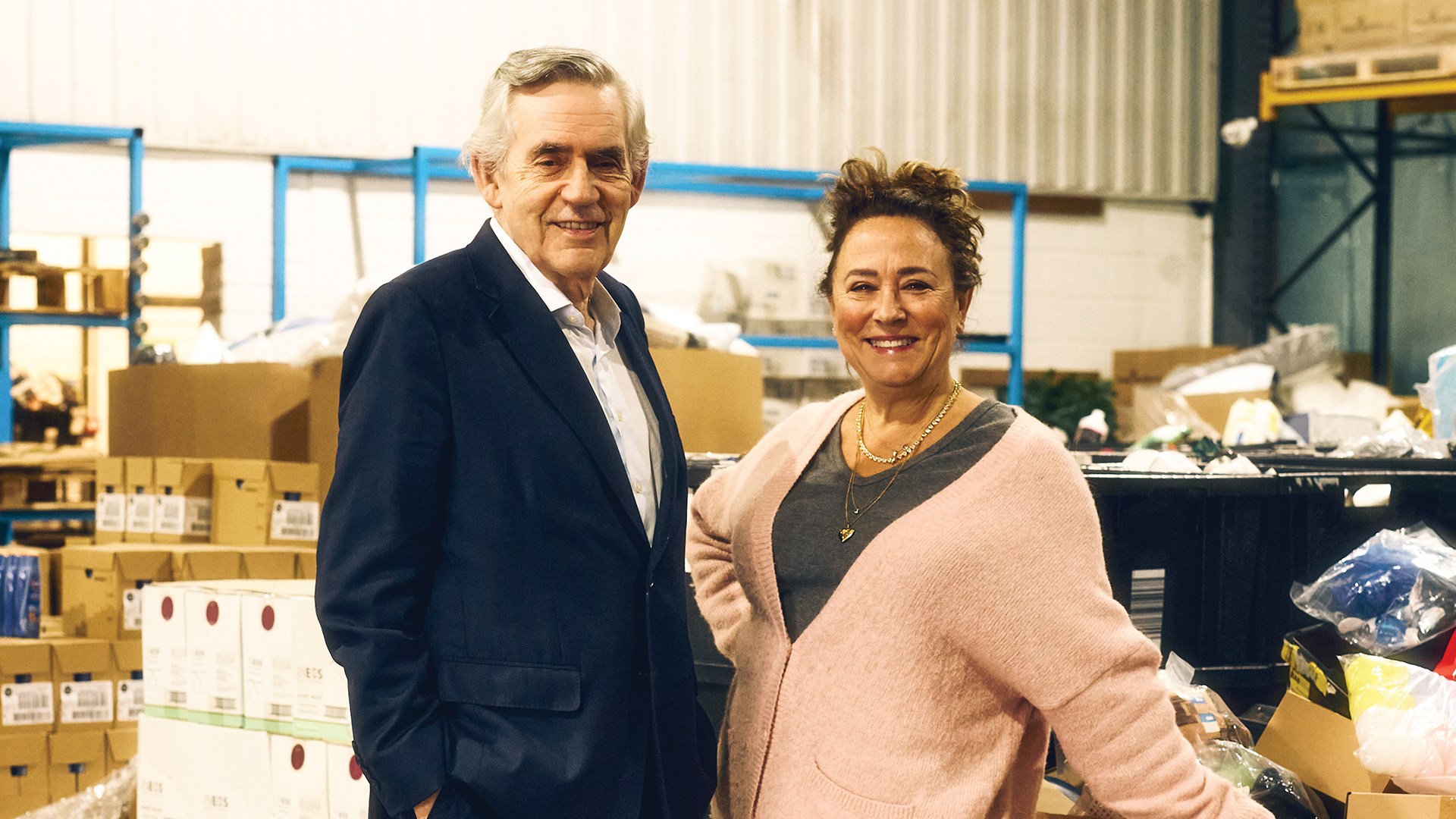
We’re in Lochgelly, base of The Multibank, also a place of significance for the Labour movement. It is here that Jennie Lee, founder of the Open University and wife of Nye Bevin, was born. There is a deep link for Gordon Brown too.
“My whole family comes from this area,” he says, “going back four centuries to 1700 or so. It’s a mining community that unfortunately has lost all its mining industry, but it’s still a very strong community, and always has been. And so, when we decided to create a multibank, this was an obvious place to come.”
The warehouse we’re in has donations from 90 companies, including Amazon, who have a major distribution point just down the road.
“It makes a huge difference to people’s lives,” says Brown, “because it’s not just a food bank, it’s a clothes bank, it’s a bedding bank, it’s a furniture bank, so you throw everything in, and you can take a holistic view of the needs of the family. So you’re not just a safety net, you’re a springboard for families getting out of difficulties.
You know, 10% of the families we have say that they would have been evicted but for the help that we were able to give them. And about 10% say that the children might have been in care had we not been able to be there for them. We’ve given out 14 to 15 million goods in total across the United Kingdom in the last year or two. And we’re going to increase that number as we get more companies involved.”
Advertising helps fund Big Issue’s mission to end poverty
The reach is extending.
Read more:
“We’ve got Wigan, which is a multibank serving Manchester, Liverpool. And the idea is that from a central warehouse, you can actually deliver goods that you get from the different suppliers, and you distribute out to people.”
Weir, a lifetime Labour supporter, has known Brown for 30 years.
“Gordon was very familiar to me – my dad was from Dunfermline, so somebody like Gordon, I think other people were like, oh no, he’s a bit forbidding. And, I went, No, he’s just like my dad. That’s what Fife was like. And so, a friendship grew.
“[The Multibank plan] came at a really good time for me, because I was just thinking, I need to do something that makes a difference. I mean, I love my job, but I just wanted to do something where I could apply my considerable bossiness and help.”
Advertising helps fund Big Issue’s mission to end poverty
Self-described as the “celebrity wrangler”, she has brought famous friends Peter Capaldi and David Tennant in as advocates and, in Tennant’s case, as an ambassador. That stardust has helped carry the Multibank message.
Recently, Multibank announced an initiative with Prince William’s Homewards project to fit out 250 homes as part of the Homewards plan to tackle homelessness. Big businesses, including B&Q, Bosch, DFS and IKEA are also part of it.
When Gordon Brown walked away from frontline politics following defeat in the 2010 election, there were 35 food banks in Britain, now there are more than 2,600, with potentially more at a very local level. Does he feel that it’s an indictment of the politicians and leaders who replaced him that such a network, and now his own with multibanks, are needed to not just plug gaps, but to prevent an even worse catastrophe for the poorest?
“Well, when we were in government, we had a child poverty act that said that we would eliminate child poverty over a period of years [In 1997 Tony Blair pledged to end child poverty within 20 years]. And we had Sure Start for under-fives. We introduced free nursery education. We then had educational maintenance allowances so kids from poorer backgrounds could stay in school and perhaps go to college and university.
We had the child trust fund that enabled people to save as kids had not been able to do before. But most of all, we had tax credits that enabled people to get themselves out of poverty. If you had a minimum wage, you could get a tax credit on top of that, depending on the needs of your children. Most of that work was dismantled by the Conservatives after 2010.
“Now we’ve got a situation where there are so many children in poverty. It used to be pension poverty that was the biggest problem, and there’s still a lot of pension poverty, but now it’s child poverty, and children are in poverty not because their fathers or mothers are unemployed, but because, in the main, they’re not paid enough for the work they do to make ends meet.
Advertising helps fund Big Issue’s mission to end poverty
You have mothers doing a back-breaking week’s work and then queuing up at a food bank. And that’s something that we really ought to be doing something about.
“I grew up here and know the area, there will always be a need for local people to come together in voluntary organisations to help people in situations which are completely unpredictable and which happen overnight, sometimes without there being proper provision for them.
At a local level, you need to know what’s happening, and you need to be right at the heart of your local community if you’re going to be able to help people. But systemic change is needed, because this can’t go on – 4.3 million people in poverty is unsustainable.”
Keir Starmer, he says, is “really is trying very hard to do, to do good things”.
Arabella Weir’s ‘real job’ will see her very familiar to millions of us over Christmas. Two Doors Down, the sitcom that started in Scotland but has broken out south of the border, is one of the BBC’s big Christmas shows. Weir plays Beth, married to Alex Norton’s Eric, the couple whose home is the meeting place for the neighbours to come and go, much of the time eating a lot of their food.
While a comedy about the small happenings of a few catty neighbours might sound like beige, tame fare, it is delivered with wit, sly observations and real heart. Right at the centre is community, people who look out for each other, even when they’re ragging each other and really annoying each other.
Advertising helps fund Big Issue’s mission to end poverty
“The thing that struck me about Two Doors Down the first time I read the script is the ordinariness of it, the unbelievable familiarity, because if you don’t like your brother or sister, you don’t have to see them, but you absolutely must see your neighbours, and unless you’re very stupid, you must find a way to get on with them,” says Weir.
“And so because people said to me, oh, you know, how can you bear Cathy? Cathy and Colin are the worst ones next door and they’re her immediate neighbours so she had better get on with them. I think that was the genius of Simon (Carlyle) and Gregor (Sharp – the show’s creators) finding that, that familiarity and just the ordinariness of it. Everybody’s got a Cathy or a Christine in their life, and you just get on with them, don’t you?”
Does Gordon Brown fancy a cameo in it, as a not-yet seen neighbour?
“No. I’m not famous enough!” he says, before extemporising, in some surprising detail, on what makes for a lasting soap or comedy series (“all sitcoms are really families”). Which begs the question, what is Gordon Brown watching on TV?
“Mainly football and sports. I’ve always watched it, since I was really young. I’ve been going to football matches and playing sport, of course, but I love watching on television.”
He’s off today to carry on carrying on. Leaving Lochgelly, he’s heading to a meeting to look into new training facilities for his beloved Raith Rovers. Raith remain soundly in the second tier of Scottish football. His mission for positive change is matched by his ongoing optimism.
Advertising helps fund Big Issue’s mission to end poverty
The Two Doors Down Christmas special is on at 10pm on Christmas Eve on BBC One.
Do you have a story to tell or opinions to share about this? Get in touch and tell us more.
Change a vendor’s life this Christmas.
Buy from your local Big Issue vendor every week – or support online with a vendor support kit or a subscription – and help people work their way out of poverty with dignity.