Chicken Shop Date star Amelia Dimoldenberg: 'Young people are always the first to bear the brunt of cuts'
Amelia Dimoldenberg is the latest Big Issue guest editor. She explains how her Dimz. Inc Academy is looking to lift up kids from from underrepresented backgrounds to level the playing field
Amelia Dimoldenberg concocted an irresistible recipe. Take a celebrity on a first date to a fried chicken shop, lean into the awkward, disarming energy of the situation. Serve deadpan questions with a side of stilted silences for a conversation that’s frequently flirty, always feisty.
The result is a series of over 100 interviews and hundreds of millions of views. Anyone who’s anyone – whether or not they eat chicken – wants to hook up, from Ed Sheeran and Billie Eilish to four-letter icons of entertainment Cher and Elmo, and in May, Sir Paul McCartney (ordering vegan nuggets and chips).
The Chicken Shop Date idea was cooked up by a then 17-year-old Dimoldenberg in 2011 and published in a magazine produced by her local youth club. Graduating to posting videos on YouTube in 2014, Dimoldenberg has spent the last decade building on the foundation the format provided. For the last three years she’s served as official social media ambassador for the Academy Awards and interviewed Oscar attendees on the red carpet. In 2025 she was named one of the 100 most influential digital voices by Time magazine.
Dimoldenberg last year launched her Dimz Inc Academy to increase opportunities for other young people dreaming of turning their passion into a living. Today it’s Big Issue’s turn to sit across from Dimoldenberg, but it’s not chicken on the table, it’s a discussion about what’s on the menu of the special edition of the magazine she’ll guest edit and why she cares so much about giving a hand up to the next generation of creatives.
We’re in Big Issue offices, you’re taking over a magazine, so what is your big issue?
My big issue is around how young people can be given more support to access the creative industries, and specifically young people from under-repre-sented backgrounds.
Advertising helps fund Big Issue’s mission to end poverty
Advertising helps fund Big Issue’s mission to end poverty
What are the obstacles preventing them from pursuing their dreams?
Within education, emphasis is mainly on doing well at exams. Most young people have passions that are never explored in school. They’ve learned a language on Duolingo on their own or they are really good at a certain type of sport or they’re interested in filmmaking, for example. There’s also a lack of entry-level jobs because they’re being taken by AI. And young people are the generation who were in their bedrooms for half of their schooling during Covid. There are probably so many knock-on effects we still don’t really know. That can mean it’s very intimi-dating to be in a room full of people or in a job interview, even more so than before. There are a whole range of reasons young people are struggling.
How did you get into the industry?
Keep reading the journalism that powers our mission
Register free to continue and learn more about the stories, campaigns and the support we provide, helping people facing poverty across the UK.
My route into what I’m doing now was through attending a youth club. Chicken Shop Date started off as a written column in a magazine called The Cut that was run out of a youth club in north-west London, which now doesn’t exist due to austerity cuts by the Conservative government. I wouldn’t be where I am today without it and as a result of meeting like-minded young people who were encouraged and supported and mentored to be able to make their ideas become a reality.
The Stowe Club closed in 2017 despite a petition you started to try to save it.
Advertising helps fund Big Issue’s mission to end poverty
Yeah, that’s why I’ve always wanted to create my own initiative, because of how much it helped me, and what I could do for other young people who are from backgrounds that are not as privileged as my own. Austerity has been disastrous for so many people around the country, but especially young people. Young people are always hard done by. They’re always the group that are first to bear the brunt of cuts. When I was at school, it was when university fees were raised to £9,000. I remember me and nearly my whole class going on the protests. That was a stark awakening to what was to come with the continued disregard for the young people in this country.
And it’s always young people who are blamed for the problems they face too.
Young people are not lazy. That is just not what the facts are. The Milburn Report that’s just come out about the more than one million NEET young people – not in education, training or employment – interviewed over 400 young people and overwhelmingly, all of them wanted to work. This wasn’t because they lacked ambition. They knew working would help lift them out of the state they were in. There’s such a wide variety of reasons why young people are not able to get the work or the training that they want to, and a lot has to do with structural changes that need to be made.
Another problem is there aren’t one million jobs ready and waiting for NEETs to fill.
Employers need to be encouraged to take on younger workers. If anything, a lot of employers are apprehensive about taking on a Gen Z workforce. There should be incentives to do so. The job market is not in the place it needs to be, but regardless, there needs to be more emphasis on training schemes and apprenticeships rather than you leave school and the only thing you can do is go to university.
Chicken Shop Date became a YouTube series when you were studying at Central St Martins. When did it seem like it could form the basis of a career?
Advertising helps fund Big Issue’s mission to end poverty
I thought I’d always be doing it on the side. When I was in my final year at uni, I spent a lot of time – probably more than my studies – on three episodes of Chicken Shop Date with [rapper] Dave, Maya Jama, and the Kurupt FM boys from People Just Do Nothing. When those were a success, when I started to make money with brands through influencing, that was when I was like, oh right, you can actually have a career through this type of work. I’ve never only been doing Chicken Shop Date but that is the thing people know me for. When my videos started to make money on YouTube, I was able to start hiring people and build a team.
You couldn’t have had a long-term business plan when you started because making a living from videos on the internet wasn’t realistic, right?
There’s no blueprint. Working within this new digital media era, me and my contemporaries are forging a path on our own. That has been the amazing thing about it. But it’s often also challenging sometimes because you’re trying to assert yourself, you’re trying to make it be known that this is a viable thing for people to get behind – not just an audience but celebrities to be interviewed. When you’re a YouTube creator, you are always really your own production company. But it’s never really spoken about like that. Having a production company was more of a PR move so that people would understand and take it more seriously, to legitimise it. Hey, I’m actually just doing something very similar to what people do in traditional media, just with a much smaller team.
For young people wanting to follow in your footsteps, is it even possible? There’s not a map to follow: finish school, launch a YouTube channel…
That’s why what we’re doing with Dimz Inc. Academy is important. It’s not a YouTube creator pipeline. We are showcasing a whole range of roles that you can do in the creative industries. From being a camera operator to a producer to directing to being the on-screen talent, all of those areas are going to be covered, and I think a lot of young people don’t even know those jobs exist. I do think in my future I’ll be doing more stuff behind the camera. It’s not for everyone to be in front of the camera – it’s also not that realistic either. So I wanted to make sure that we’re setting people up for a realistic version of success.
What skills do young creatives need today that aren’t going to be taught in traditional education?
Advertising helps fund Big Issue’s mission to end poverty
In traditional education you are taught to work within the boundaries of what you need to get marked on. Creative thinking has really benefitted me throughout my career. My success is due to thinking outside the box, subverting narratives and often in a lot of schooling that’s not rewarded. The arts in general aren’t prioritised at school. I was lucky that I went to a school that specialised in performing arts.
More broadly, being in the creative industries, you need to learn how to collaborate with others because you don’t do anything on your own. What I learned from university, but also at the youth club I went to, was the power of collaborating with your peers and how you can ask for help from them. A friend might have that camera you need to film something, or can be a sounding board. I’ve always found I need someone to bounce my ideas off, and that could be encouraged more.
Will the rise of AI make creative skills even more crucial?
Yeah, it’s almost like in reaction to AI, humans tapping into their own creativity. That is something we have the upper hand on. Every job is creative in some way, so if you’re able to harness your creativity then that will benefit you in whatever you choose to do, whether it’s being an artist or a plumber.
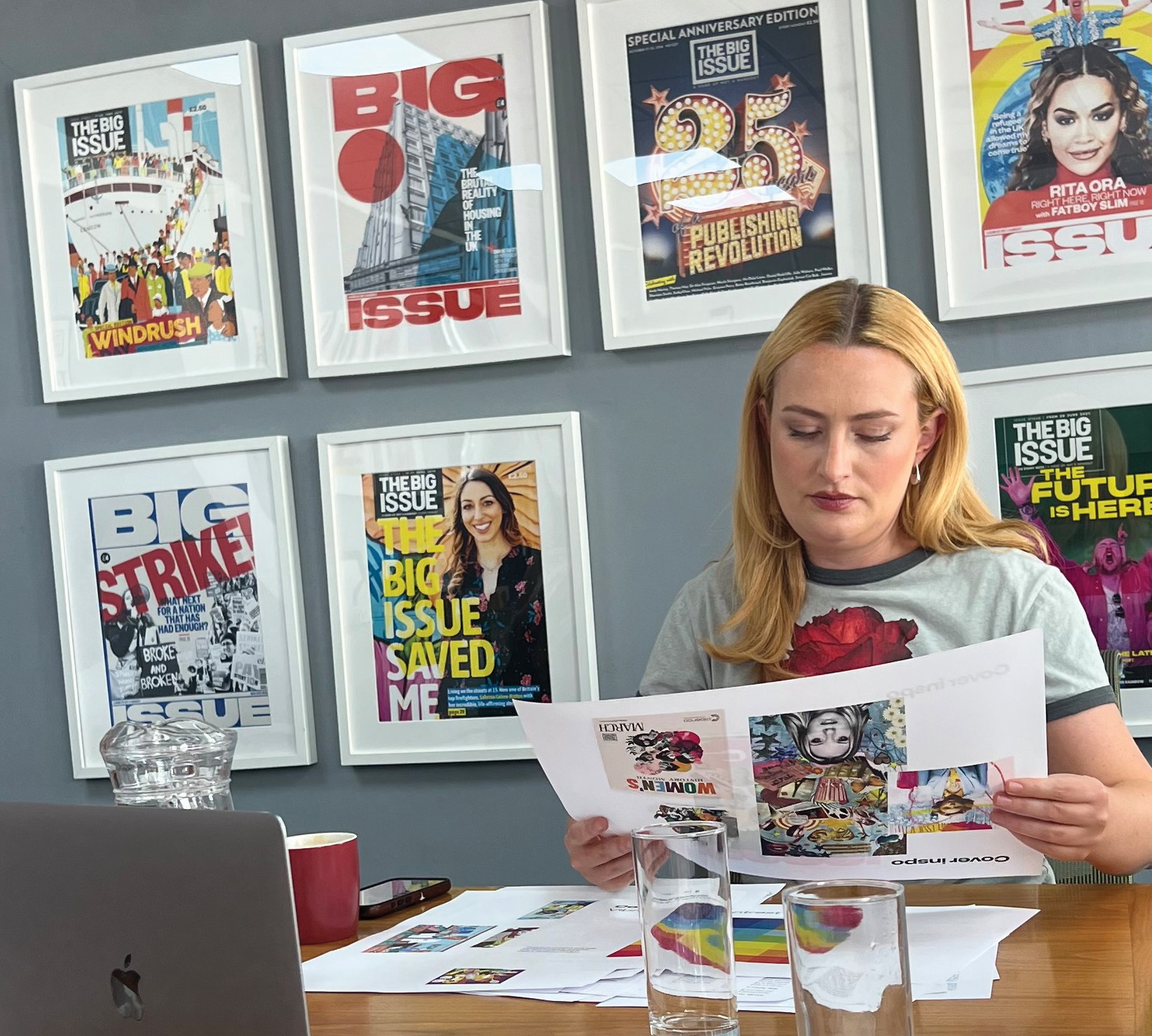
Amelia Dimoldenberg visits Big Issue HQ. Image: Big Issue
Plenty of people who have a platform don’t bother to use it to give a hand up to others. Why do you?
I guess it’s because of how I was raised by my parents. They have always been incredibly politically motivated. My dad is a local politician. My mum’s a librarian. She’s retired now, but the importance of community organising was instilled in me because that’s who they are, that’s their bread and butter. Growing up I’d either be in a library or I’d be in a Labour Party meeting, sitting on the side. That’s just part of my value system, it would always be the case that I would want to try and galvanise other people or create something that involved people coming together.
Advertising helps fund Big Issue’s mission to end poverty
Who do you have in mind for students at the Academy?
We’re working with an amazing charity called Spiral Skills and they have their own network of young people, but we also put an application form out on our Dimz Inc website. We’re looking for people from underrepresented backgrounds, to do my part to level the playing field.
What does the course look like?
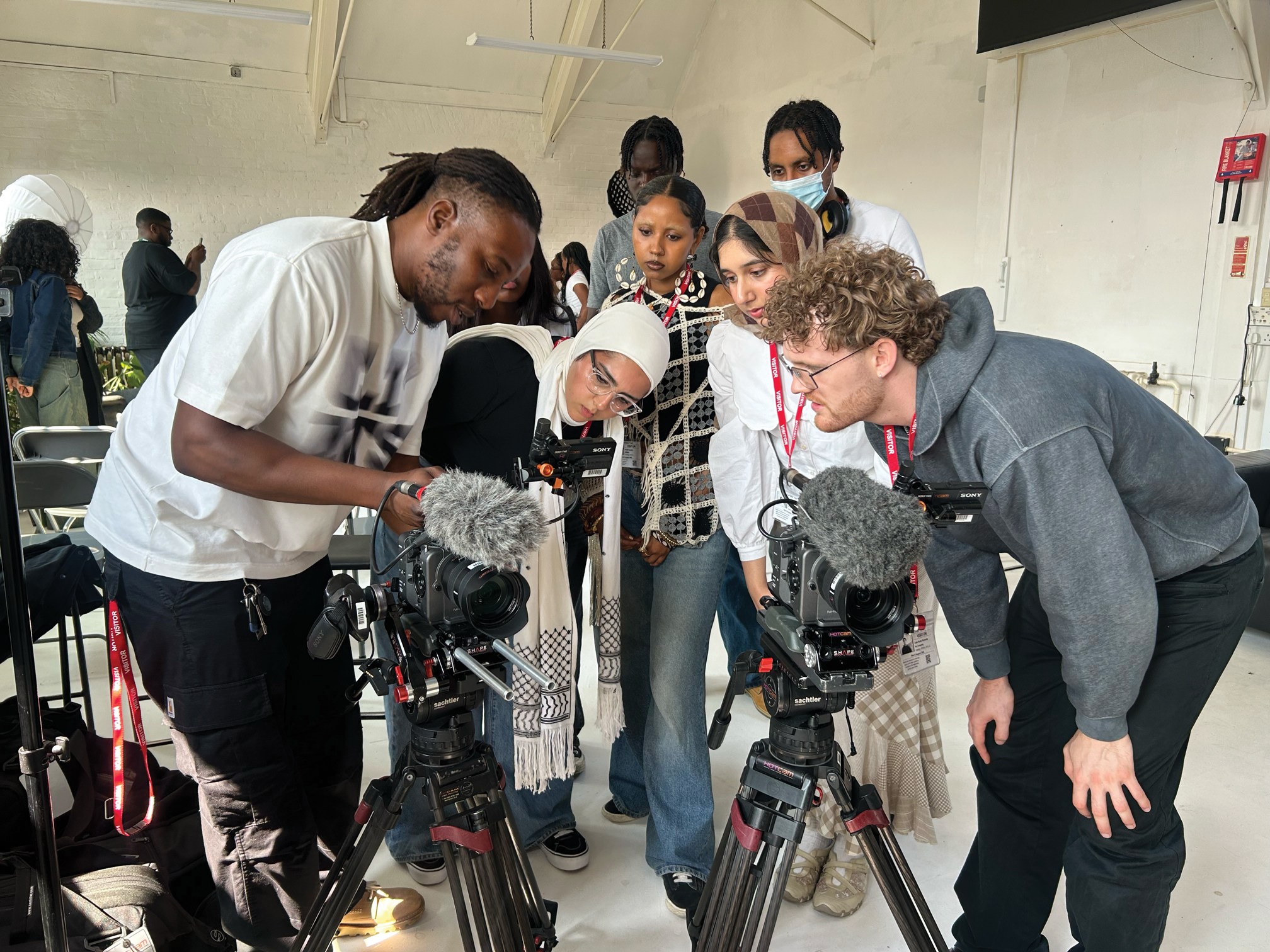
It’s four weeks long. The young people are going to be in four groups of four and think about a video they would like to create, whether that’s a short documentary piece or an interview format similar to Chicken Shop Date. They can figure out what they’re drawn towards. Then we’ll have a range of different professionals coming in every week and they’ll be able to listen to their stories. In the last week they’ll have sessions on how to market their video piece, then they’ll showcase to a set of professionals, they’ll get feedback and their work will be shown at Southbank Centre.
What have you learned running the Academy?
I was going to say I learned that young people are passionate and ambitious, but I already knew that. So it reasserted that belief in me. I learned how impressive young people can be and also that young people are full of ideas. What they need is the confidence and support network to go and do it. That’s what I’m hoping to provide for the future.
Advertising helps fund Big Issue’s mission to end poverty
What happens to the one million people not in education, work or training when they have the ideas and ambition but are never given opportunities?
That’s how you probably end up with disillusioned adults. You know, adults that are unhappy or frustrated in their lives. The vast majority of the over one million young people have everything they need to get employment but they are in a rejection loop. They just need someone to open a door for them. They need someone who knows someone to send their CV to someone. They need nepotism, basically. So I encourage people who can open their network, who can create opportunities and put people forward for work experience placements, to do so because that’s definitely a way we can help.
Across four weeks, the programme provides young people aged 18-24 with free practical experience, industry mentoring and work placements. The participants work collaboratively in teams to create original digital content, receiving guidance from industry professionals.
WEEK ONE
A focus on vision, ideation and development, introducing participants to the creative industries while helping them shape and pitch original concepts.
WEEK TWO
Advertising helps fund Big Issue’s mission to end poverty
Exploring production and filming, including the opportunity to shadow a Chicken Shop Date shoot and gain first-hand insight into how professional productions are made.
WEEK THREE
Centring on editing and creative development, with participants shooting their own projects and learning industry-standard post-production skills through workshops and masterclasses, including Adobe Premiere Pro training.
THE FINAL WEEK
Focusing on feedback, showcasing and future progression, culminating in participants presenting their work to a curated group of industry professionals, partners and invited guests.
Beyond the programme itself, every participant will receive a guaranteed paid work placement, ongoing one-to-one mentoring and career support from Spiral Skills, as well as access to the Dimz Inc. Academy alumni network. All applicants also receive a £300 bursary to support their participation.
Advertising helps fund Big Issue’s mission to end poverty
Spiral Skills is a youth-led, community-rooted charity based in Lambeth. Since 2015, the organisation has helped more than 5,000 young people build confidence, discover their own strengths and realise their potential.
Everything they do is rooted in three simple ideas:
DEVELOP Helping young people build confidence, essential skills and belief in themselves through immersive programmes, mentoring and long-term support in schools, pupil referral units and community settings. They create safe, non-judgemental spaces where young people feel seen, supported and able to take risks, learn and grow.
CONNECT Opportunity changes lives when it’s matched with the right support. Spiral Skills brings together employers, mentors, educators, community organisations and local services to create an ecosystem of support around every young person. Alongside pathways into work, education and creative careers, young people are helped to navigate challenges around housing, wellbeing and financial insecurity, ensuring they can access opportunities.
EMPOWER Supporting young people to become leaders, advocates and changemakers. Many progress from participating in programmes to designing and delivering them, influencing policy, advising funders and public bodies, launching community projects and creating opportunities for others.
Spiral Skills’ work has received recognition, winning the London Youth Social Action Award 2025, featuring in BBC Children in Need’s national campaign, and welcoming HRH Prince William through the Homewards programme, showcasing an early intervention and community-based approach.
Advertising helps fund Big Issue’s mission to end poverty
Dimz Inc. Academy also works with Young Creators UK CIC, a youth-owned, impact-led creative agency pioneering youth equity in the UK creative sector. It combines professional creative delivery with the infrastructure young people need to access, develop and hold value: space, equipment, software, training, paid work, networks, leadership and ownership.