TikTok points out that 97% of its moderation is already done algorithmically. Illustration: Big Issue
Share
After working at TikTok for three years, Lynda Ouazar is sure of one thing: she will never let her children use the platform.
“I know how the algorithm works,” the former content moderator tells Big Issue. “I know the risks with addiction, with bad content, and there are lots of other issues people don’t know about. It’s not just people dancing, or cooking, or singing.”
TikTok removed more than 188 million videos in the second quarter of 2026, the latest period for which data is available. More than 97% were removed using automated detection technologies, the company says – but human moderators “protect the public” from what slips through the algorithmic net, Ouazar explains.
“What you see is pornography, and lots of it, terrorism, a lot of terrorist organisations that you need to control, child sexual exploitation, rapes, self-harm, accidents, animal abuse,” she says. “Anything that would shock viewers, we make sure that we remove it.”
Ouazar describes moderators as the “front line” of TikTok. But as the content giant pivots to AI-first moderation, this front line is being thinned. In August 2025, the company announced plans to lay off hundreds of its London-based moderators.
In December, roles in the related Traffic and Ecosystem department were cut, and Ouazar lost her job. She attributes this dismissal to her union membership – “everyone who was fired was a union member” – though TikTok strenuously denies these allegations. Both sets of redundancies are currently being challenged in the courts. Former employees including Ouazar are alleging union-busting.
Advertising helps fund Big Issue’s mission to end poverty
Advertising helps fund Big Issue’s mission to end poverty
It’s a significant moment, says Tom Hegarty, from Foxglove, the non-profit lawyers who are helping the moderators bring their case. If they succeed, it’s proof that big tech can’t just “do what it wants and ignore employment law” as it rolls out AI. But there’s also a more existential dimension, too: as automation comes for more and more jobs, who benefits – and does it come at the risk of online safety?
“Social media companies were forced to do content moderation. It’s not their choice,” says Hegarty. “It is just the minimum they could get away with in terms of public outrage over harm being spread online. So yes, if you are looking to find the cheapest way of making it look as though you are doing something to keep people safe online, then saying ‘Oh, we’ll just throw ChatGPT or Claude at it’ obviously seems like the most cost-efficient solution. But is it a good solution?”
What’s it really like being a TikTok moderator?
Keep reading the journalism that powers our mission
Register free to continue and learn more about the stories, campaigns and the support we provide, helping people facing poverty across the UK.
Lots of people watch short-form content to decompress after a long day. When Iman Morshed was employed at TikTok, this was a pretty unappealing post-work diversion.
“At the end of the day of moderating, my brain would pretty much feel like mush already… so I’d try to do something else,” he tells Big Issue.
The 27 year-old worked at TikTok for two years, checking content for breaches of the company’s guidelines. He’d log in at 8am or 3pm, depending on his rota, and check messages from his manager.
“Then, in the grand scheme of things, I’d spend essentially eight hours of the day watching 10-second portions of live streams,” he recalls. “It could end up being a thousand streams in a day.”
“I would determine in those 10 seconds if it broke any rules. If it did, I’d apply the relevant policy – if the person was smoking, for example. If they were driving, whatever. Watch, moderate and move on.”
Like Ouazar, Morshed was also made redundant by TikTok – but he is not involved in any court proceedings against the company. Losing his job was unexpected, Morshed tells Big Issue, but not altogether unwelcome: “After two years I felt I was pretty much turning into a zombie.”
Ouazar agrees that the work can be gruelling – however, she describes it as “in some ways, a dream job”.
“It was very hard, but on a personal level, it was very fulfilling, knowing that I’m keeping the platform safe – especially since I have young children myself,” she says. “I was telling myself: imagine if we are not controlling that, what would the platform be like?”
After a promotion brought Ouazar to the related Traffic and Ecosystem department, she stopped enjoying her job. Ouazar alleges she experienced bullying, exclusion from projects and public shaming by her manager.
“It took me quite some time to look at the bigger picture and join all the dots and say like, ‘Oh my god, they’ve been doing all of this because of my union membership’. I fell into depression.”
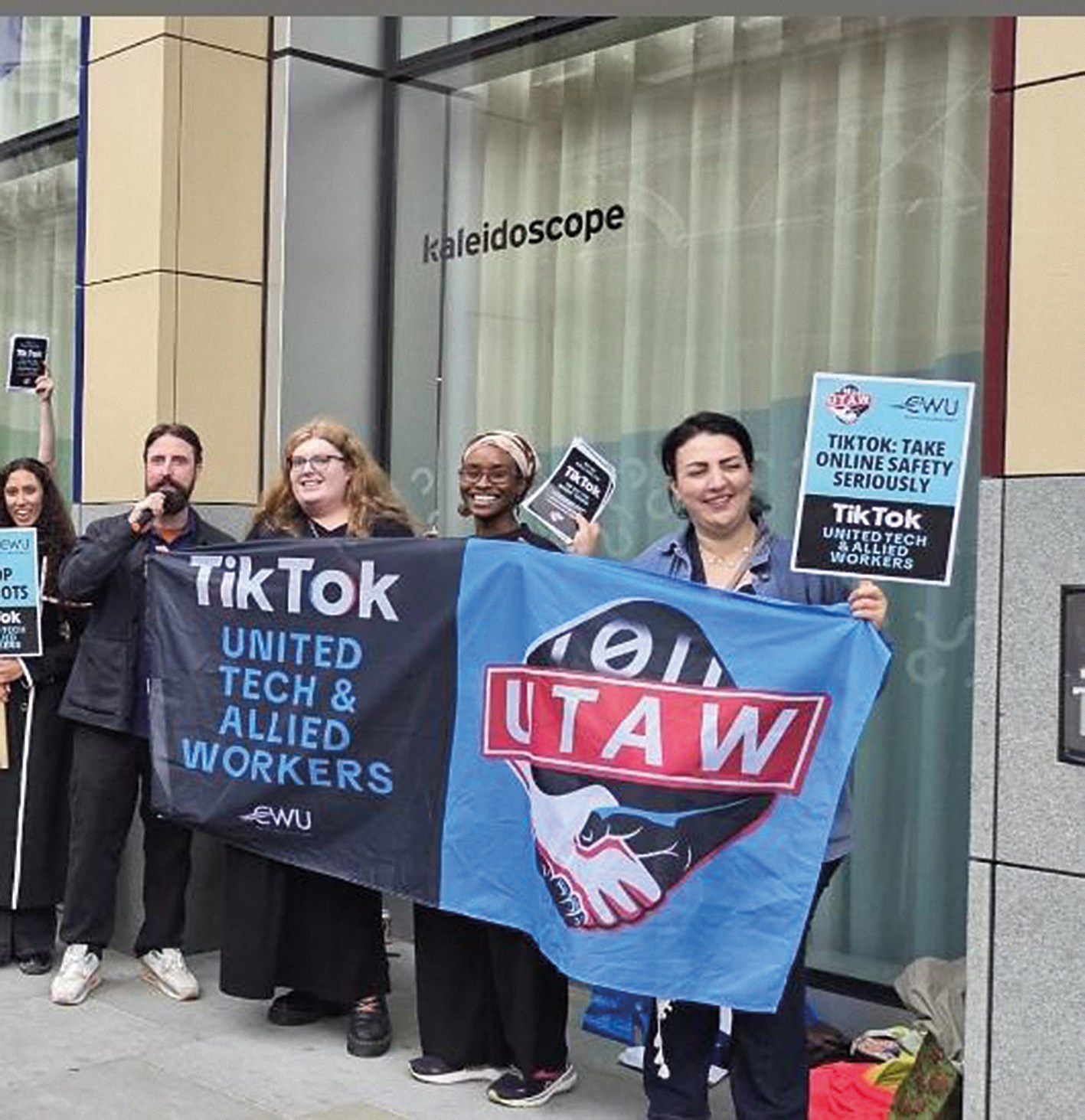
Lynda Ouazar (above right) with former tech workers protesting TikTok redundancies
Meanwhile, the company was already under fire from other former employees with similar allegations of union busting. Moderators who were made redundant in August were taking the company to court, with the assistance of Foxglove. The case revolved around timing of the redundancy announcement: it came just seven days before workers were due to vote on forming a union.
“That TikTok management have announced these cuts just as the company’s workers are about to vote on having their union recognised stinks of union busting,” alleged CWU national officer for tech John Chadfield.
Then, in December, Ouazar was told she was up for redundancy. Everyone who was up for redundancy was a union member, she alleges.
This second round of cuts is also being challenged in the courts. In February, four members of the Traffic and Ecosystem team – Ouazar among them – brought a case alleging they were dismissed because of their efforts to organise their own team into a union, as well as their support for the content moderators’ campaign.
At the end of October, the next hearing for the case was set for January 2029, so Ouazar and her former colleagues have a long time to wait. Ouazar is ready for it. “TikTok is a big company. They give you a little bit of money and they want you to sign an NDA. But we refuse to take that humiliating money in return for shutting our mouth. We want justice,” she says.
A spokesperson for TikTok declined to comment on ongoing litigation but added that the company “strongly rejects the allegations”.
“Last year’s reorganisation of our global operating model for Trust and Safety was designed to ensure we maximise effectiveness and speed in our moderation processes,” they said. “We continue to use a combination of technology and human teams to keep our users safe.”
So do these automated models really work?
TikTok points out that 97% of its moderation is already done algorithmically. But recent research has cast some doubt over the efficacy of its systems. This year, University of Bath researchers put TikTok’s moderation system to the test. They identified 455 UK-facing accounts offering to supply drugs through TikTok and reported them using the platform’s in-app reporting tool. More than 95% of reports came back cleared, each one after exactly 30.5 minutes.
“We could not determine whether decisions were made by automated systems, human moderators or a combination of both,” says professor Chris Pudney, who led the research. “However, the fact that every ‘no violation’ decision was returned at precisely 30.5 minutes suggests that at least some automation is likely to be involved in the process.”
Hegarty points to this study as an example of the limits of automated moderation. “It’s clear that just automating it and saying, ‘Oh well, the machines can handle it for us’ isn’t working.”
Part of that is down to design itself. All social media depends on “getting as many eyeballs as possible on content,” Hegarty continues, “and then making it as hard as possible for those eyeballs to be taken away.
“Unfortunately, the content that does keep people clicking most is horrible stuff. So the cynical decision I think was made, by all social media companies, for algorithms to prioritise that content at all costs, so you can sell more ad space.”
The algorithmically driven profit imperative is never going to align perfectly with public safety. In 2023, Amnesty International research using accounts designed to mimic young teenagers found that TikTok’s content recommender system could amplify depressive and suicidal content, pushing users down a dangerous “rabbit hole”.
Morshed is unsurprised: “It’s what you expect from tech,” he says. “It’s how can we squeeze people’s attention spans that extra bit more? How can we fit more advertising in here? How can we optimise our algorithm to show people what they want to see more of, to keep them on our apps to increase our engagement?”
“As far as tech companies go, I think it’s pretty standard in that way of really trying to push their own relevancy and push how much they can squeeze out of the individual consumer at the expense of the greater good.”
Ouazar believes that moderators were one of the ways of shielding users from the worst of that eyeball-catching content. But she is no longer one of them.
“Imagine you’re being made redundant. You know that it’s not fair. It’s really wrong. But then you find yourself signing an NDA because you cannot challenge a company that big,” she says.
“I didn’t want that to happen to me, so we are taking them to court.”