“It can be a matter of life and death.”
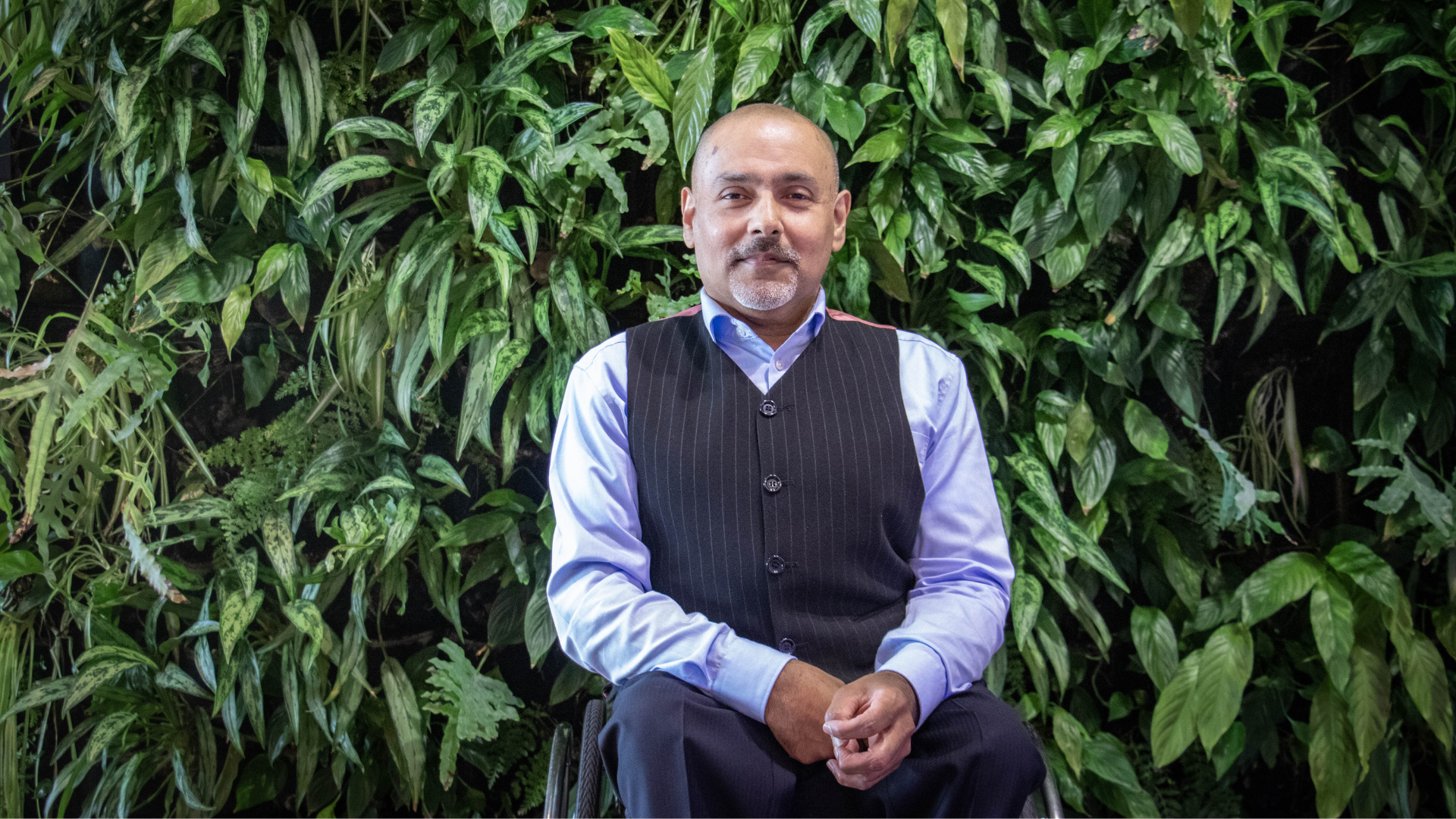
Mallick was rescued by his neighbours, who heard his shouts and broke down the door. But he lost “everything” in his flat, and still “doesn’t sleep” whenever it rains: “It left me with just this acute anxiety… You kind of keep waking up and checking, is it still raining?”
The incident was nearly 20 years ago. But as climate change accelerates instances of extreme weather, Mallick – now chief executive of Disability Rights UK – is sharing his story to raise awareness of the risks flooding poses to disabled people.
Keep reading the journalism that powers our mission
Register free to continue and learn more about the stories, campaigns and the support we provide, helping people facing poverty across the UK.
Britain is now 10% wetter than it was in the late 20th century and six of the ten wettest winters on record have occurred in the last 20 years. Some eight million homes will be at flood risk by mid-century, up from six million today.
Big Issue has previously spoken to flooded people about the heavy toll extreme weather takes on their mental health and finances. For disabled people, such problems are often compounded.
According to new Friends of the Earth analysis, some 611,000 people in flood risk areas are at “high social risk” – less able to prepare or to recover afterwards due to factors such as living on low-incomes, disability, and lack of insurance.
Advertising helps fund Big Issue’s mission to end poverty
At least 117,000 of the high risk group are disabled. Disability transforms calculations around flood “resilience” entirely, says Mallick.
“I can’t go and lift sandbags, even if I had them. I couldn’t push my chair and hold that sandbag… so my only preparedness is to get out of the property, and if it floods, it floods, and as long as I’m not there, and you take what you can with you and what your essentials.”
Roughly a third of disabled people live in poverty, 12% higher than the national average. But floods threaten vital and expensive electronic equipment like respiratory machines and wheelchairs.
And once the waters have settled, disabled people are often left with nowhere to go. According to recent research by the National Emergency Trust and Lancaster University, some 61% of people impacted by floods had to leave their homes, with 37% living elsewhere for a sustained period and 5% never returning.
For disabled people, the housing question brings additional complications.
When his home flooded, Mallick had to move out. But the housing association didn’t have another accessible property that they could place him in, so he had to take on an expensive short-term tenancy. When the property was fixed, months later, he moved back in.
Advertising helps fund Big Issue’s mission to end poverty
It’s not ideal – the ground floor of a building constructed atop a dip in the ground, the house is still a flood risk. There have been times when the water has reached his door.
“You know that saying ‘better the devil you know?’” Mallick asks. “I went okay, I’ll go back to where I’ve just been thrown out of.”
He had little choice: accessible social housing is hard to come by.
Back in 2009 there were just 900,000 fully accessible homes in England for a disabled population of 11.4 million people, leaving an accessibility gap of 10.5 million.
But by 2022, the most recent figures available showed that 16.1 million people were registered disabled but the number of fully accessible homes only increased to 3.3 million. According to analysis by the Centre for Ageing Better, that means the accessibility gap grew to 12.8 million.
“We’re not building enough homes and we’re not building enough affordable homes. And we’re not building enough accessible homes,” Mallick said. “So there’s just massive supply problem, which means that if you are in a property that is at risk of flooding, the chances of you being able to move are almost impossible.”
Advertising helps fund Big Issue’s mission to end poverty
Poor planning is making the problem worse. In the drive to build, new homes are still often constructed in flood zones.
According to data published by the insurer Aviva in February, one in nine new homes in England built between 2022 and 2024 were constructed in areas that could now be at risk of flooding.
Head of policy at Friends of the Earth Mike Childs called on the government to rethink planning permission in these areas – and to develop a “coherent national adaptation plan.”
“You need to make sure that the local authorities and emergency services have the funding they need to be able to help respond to flood events.”
A National Audit Office report from 2023 found that the Environment Agency has scaled back its flood protection plans and is “struggling to maintain” existing defences.
Better financial support for impacted victims is necessary too, Childs added. 85.4 % of the ‘high social risk’ group polled by Friends of the Earth are income deprived.
Advertising helps fund Big Issue’s mission to end poverty
“So many households will be at additional risk, because they can’t afford to prepare in advance of floods,” he said
“You really need to be able to think about how you help those homes with basic flood resilience measures that will mean that the flood water is less likely to come into the house.”
If governments fail to curb emissions and the climate crisis is left to spiral, more people will be pushed into flood risk.
“It kind of creates that feeling of that actually your home is never safe,” Mallick says.
He’s just glad that his neighbours were in the night he got trapped in flood water.
“Where I live, the windows don’t even fully open. Because it’s a ground floor, for security, they don’t fully open, so you couldn’t get out of them.”
Advertising helps fund Big Issue’s mission to end poverty
“It can be life and death.”
Do you have a story to tell or opinions to share about this? Get in touch and tell us more.
Change a vendor’s life.
Buy from your local Big Issue vendor every week – and always take the magazine. It’s how vendors earn with dignity and move forward.
You can also support online: Subscribe to the magazine or support our work with a monthly gift. Your support helps vendors earn, learn and thrive while strengthening our frontline services.