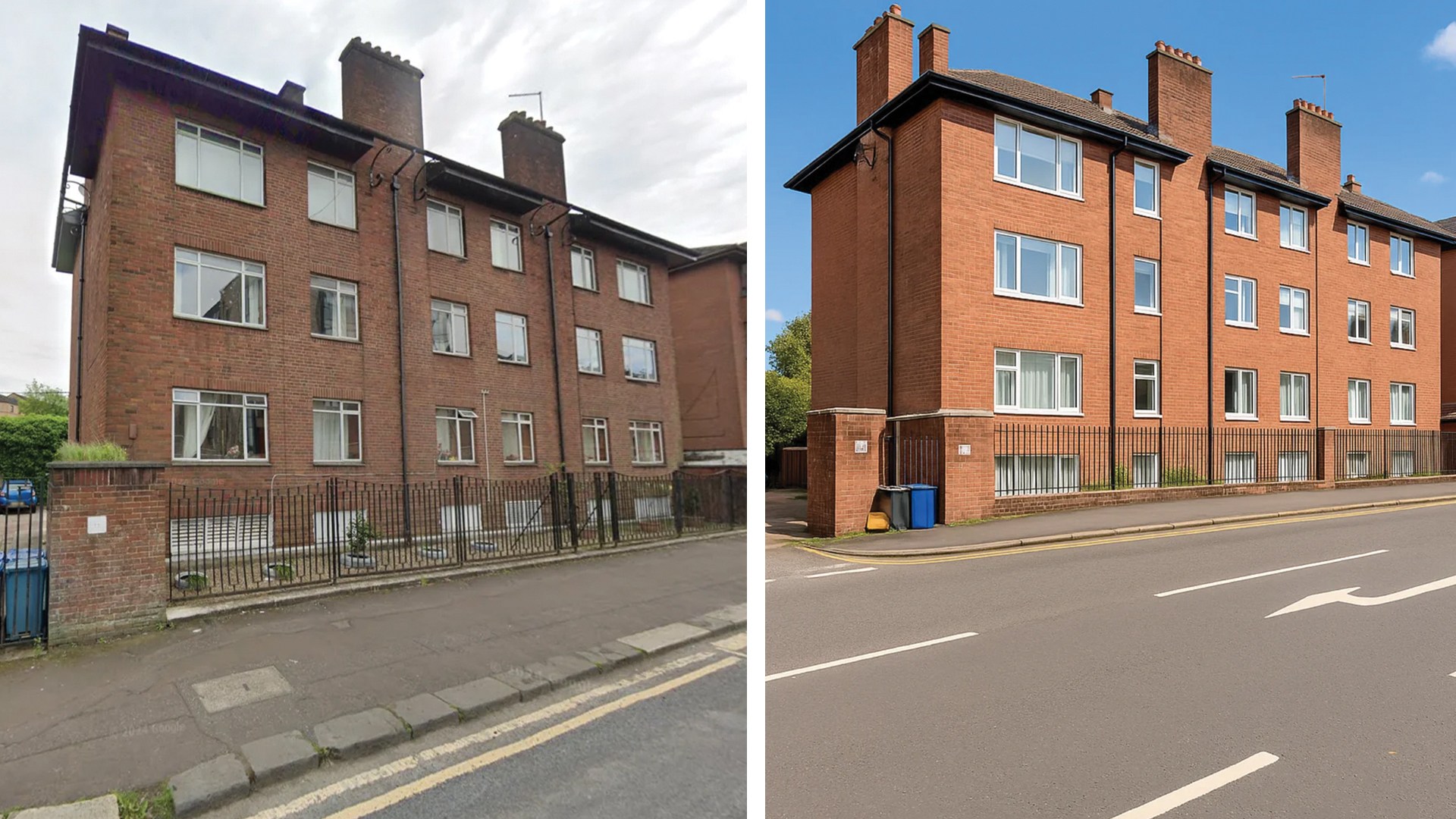
(Left) the reality and (right) with AI enhancement. Images: rightmove.co.uk and AI enhancement
Share
Holly and Richard were excited to move to London and start new jobs. And with three months to find somewhere to live, they thought they had plenty of time. They soon realised otherwise.
The search for a two-bedroom flat around Brixton and Streatham in London proved stressful and fiercely competitive. It was only three weeks before the move that they finally found somewhere.
“There was a lot of pressure to bid,” Holly tells Big Issue. “You never know if it’s true or not, but we would be told there were three or four other people bidding with you. That led us to make quite quick decisions.”
Because Holly and Richard weren’t yet living in London, they had to do almost all their viewings remotely – relying on photographs and letting agents to give them an honest picture of the place they might soon call home.
That was when Holly began to notice something strange. At first, it was the furniture. Rooms looked immaculate, the lighting suspiciously perfect.
“It looked like they’d had an interior designer in,” she says. “You could just sort of tell it wasn’t real.”
Advertising helps fund Big Issue’s mission to end poverty
Advertising helps fund Big Issue’s mission to end poverty
Then came something harder to dismiss. One property appeared to have a beautiful, leafy outlook – no small selling point in London, where finding a home with greenery can be difficult.
But when they were shown around, the view through the window was very different.
“That is so important to your property,” Holly says. “To think that’s what you’re going to have and then for it to not work out that way is quite frustrating.”
Keep reading the journalism that powers our mission
Register free to continue and learn more about the stories, campaigns and the support we provide, helping people facing poverty across the UK.
For Holly, it also raised a more fundamental question of trust.
“When you’re not in the area you’re trying to rent in, you’re putting a lot of trust in the person showing you the house,” she says.
“If they are using AI to manipulate listings and you physically can’t get there to view it, you’ve got to trust that what you’ve been shown properly represents it.”
Advertising helps fund Big Issue’s mission to end poverty
The technology can virtually furnish empty rooms, helping renters to visualise a home’s potential. But it can also blur a fundamental distinction between showing renters what a property could look like and showing them one that doesn’t actually exist.
Some listings go considerably further than adding a virtual sofa. Big Issue has seen ads where generative AI appears to have created doors and even entire rooms that do not exist. In another, images of a flat bathed in natural light bore little resemblance to the reality: a dark, windowless basement property.
At what point, then, does helping renters visualise a property’s potential become advertising a home that simply isn’t there?
“Renters don’t have time to be misled.” That is the stark assessment of Eleesha Taylor-Barrett, national chair of renters’ union ACORN.
“Renters are already being asked to pay extortionate sums for housing while spending huge amounts of time trying to find somewhere suitable,” she says.
Advertising helps fund Big Issue’s mission to end poverty
“People are sifting through small, inadequate or poor-quality properties all the time and squeezing viewings in between work, family and everything else in their lives.”
For Taylor-Barrett, a wasted viewing matters.
“If someone wouldn’t have booked a viewing had they seen an honest representation of the property, they shouldn’t have been misled into going in the first place.”
Some renters may not even get the opportunity to discover the difference. In highly competitive areas, some are making offers without viewing properties first, says Dan Wilson Craw, deputy chief executive of Generation Rent.
“AI-manipulated images give renters a false idea of the home and can lead to renters making misinformed decisions about the place they live,” he says.
“Honesty is the bare minimum that a landlord or letting agent should be offering a tenant,” Taylor-Barrett adds.
Advertising helps fund Big Issue’s mission to end poverty
“Renters are making huge decisions based on these listings, deciding whether somewhere could be their next home and whether to hand over a significant amount of their income for it every month.
“They should be able to trust that what they are being shown is real. Imagine committing to a tenancy and moving your life into a new home, only to discover you’d been lied to about what you were getting.
“And you’re then expected to trust the same landlord who misled you to deal with repairs, keep your home safe and fulfil their responsibilities to you. That’s a terrible foundation for a relationship in which one person already holds so much power over another person’s home.”
So who is responsible when a listing crosses the line?
Taylor-Barrett is unequivocal: responsibility lies with landlords and letting agents. “They are the ones making money from people’s need for a home and they have a responsibility to advertise those homes honestly.
“If a property is damp, mouldy, cramped or in poor condition, landlords shouldn’t be able to use AI or any other technology to hide that.”
Advertising helps fund Big Issue’s mission to end poverty
New York is already grappling with this question. Mayor Zohran Mamdani’s administration has announced plans to require landlords to disclose when rental listing images have been altered using AI or other digital tools.
The proposals stop short of banning AI imagery. Instead, renters would be told when what they’re looking at has been digitally altered.
In Britain, the route to redress is less straightforward. Wilson Craw says that once a renter has entered into a tenancy, responsibility should ideally sit with whoever their agreement is with – usually the landlord. That would give landlords an incentive to make sure that their agents advertise their properties honestly.
The Renters’ Rights Act will introduce a landlord ombudsman, but it is not yet in place.
Until then, renters can complain to a letting agent and seek redress through the scheme it is required to belong to.
There is also an obvious business reason for landlords to think twice before allowing AI to flatter reality. Under reforms introduced by the Renters’ Rights Act, Wilson Craw points out, tenants can leave with two months’ notice.
Advertising helps fund Big Issue’s mission to end poverty
“Misleading imagery could see renters moving out of homes that they have been mis-sold,” he says, “forcing the landlord to then put it back on the market.”
What a room is really like… and how AI thinks it could look. Images: rightmove.co.uk and AI enhancement
When AI gets it right
For all the concerns about misleading imagery, Charlie Lamdin doesn’t believe AI itself is the problem. The founder of housing marketplace BestAgent and presenter of Moving Home with Charlie points out that property photographs have long distorted reality. Wide-angle lenses can make rooms appear bigger simply because they are needed to fit the whole room into a photograph.
The difference, he argues, is whether the distortion is deliberate.
“Making rooms look bigger isn’t an intentional trick, whereas using AI to manipulate room appearance is,” he says.
Lamdin doesn’t believe altered images should necessarily be banned. Instead, he says agents should label them clearly and include photographs showing the property’s original condition.
“There’s no harm to using AI to create ‘what it could look like’ images,” he says. “In fact, this can genuinely help a tenant see what living there could be like and give them ideas for furniture layout.
Advertising helps fund Big Issue’s mission to end poverty
“AI-manipulated images aren’t a major risk to tenants, but they are an indication that an agent is willing to be dishonest, if they don’t mark the images appropriately.”
Lamdin doesn’t believe new AI-specific rules are necessarily needed. Existing laws preventing agents from knowingly misrepresenting homes are sufficient, he argues, but are not properly enforced “because the government department responsible is hopelessly understaffed”.
But photographs are only one part of the rental process AI could change. And here, Lamdin sees considerably more potential.
“AI should be used on the administration side of the process by all parties, so that there can be more human contact time,” he says. “Human judgement will always be important in home moving.”
Holly, despite her experience, isn’t opposed to the technology either. She found virtual staging useful when it helped her picture how she might furnish a room.
“If they are using it, can we just make sure that they’re using it carefully?” she says. “The agent needs to know the property and make sure AI hasn’t manipulated it in a way that gives an inaccurate representation.”
Advertising helps fund Big Issue’s mission to end poverty
A virtual sofa, in other words, might help someone imagine their future home. A leafy view that isn’t there is something else entirely.