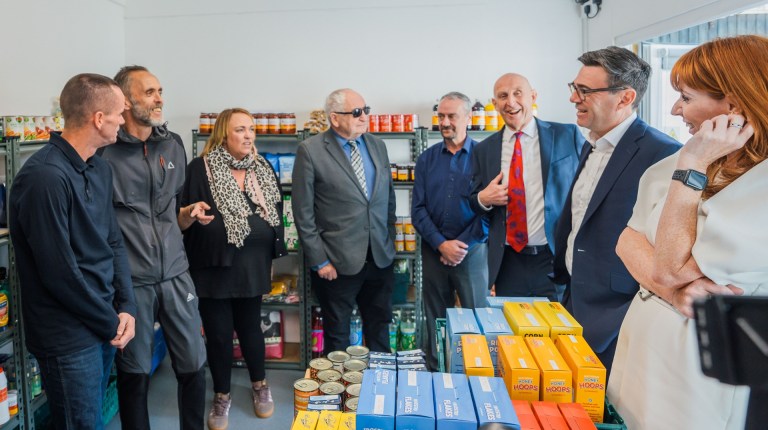
It feels exciting. We now have a prime minister fully committed to this. This is such an important agenda. And it’s not just about words, it’s about action. I’m really pleased that the vital funding to help councils, charities and voluntary groups lead on that mission has gone out. They’ll be receiving £121million to start working towards that end goal of making sure no one is sleeping rough by Christmas.
Do you believe you can achieve this goal?
The government can’t achieve this goal on its own. There are so many fantastic organisations like Change Please, charities, faith groups, voluntary groups – all of them are vital in making sure we work towards this. It shouldn’t be a goal that we feel that is insurmountable. It’s a goal that we should all be working to. And for me, it’s making sure that we’re not just looking at making sure people have a route off by Christmas. It’s about after. It’s about the vital support that people sleeping rough will need after Christmas as well.
Keep reading the journalism that powers our mission
Register free to continue and learn more about the stories, campaigns and the support we provide, helping people facing poverty across the UK.
Read more:
What will be your main priorities beyond giving people a route off the streets?
It’s looking at the root causes of homelessness, getting a better understanding of why people are sleeping rough and ending up on the streets in the first place. It’s also making sure, when we are getting people off the streets, they have access to additional wraparound services they need, whether it’s access to mental health, access to substance abuse treatment, access to good examinations, dental care, all those key things we take for granted.
Advertising helps fund Big Issue’s mission to end poverty
It’s not just about a safe bed for you to sleep. It’s a long-term thing. And vitally, it’s making sure that once people who are sleeping rough come off the streets, they don’t end up back there. That will only happen if they have got a good, secure home, a good secure job, where they can pay their way and get long-term employment, so they are able to live independently.
You experienced homelessness yourself as a child. What does it mean to you to now be in a position to change people’s lives?
There are some things that stay with you, some experiences that you vividly remember. I still vividly remember when we had to leave and go into a B&B. We were just in one room. I still remember having to pack bags, dragging a suitcase and a black bag. And to know that the experiences of my childhood are still going on now, that makes me sad. That makes me even more determined to make sure that we address this and we fix this.
We can do this. I know that so many children are still living in temporary accommodation, not having a safe home to call their own. It makes me sad that so many people are still sleeping rough because of an issue with their landlord.
But the Labour government is making key areas of legislation to help fix that. Ending no-fault evictions will go a long way to helping people stay in their homes. We’re looking at support for care levers under 25, so that they don’t find themselves with that really inhumane terminology of ‘intentionally homeless’. We’re providing support for some of those vital groups, our veterans, women fleeing domestic abuse. These are key areas that, as the new minister, I’m going to push.
How did your experiences in temporary accommodation impact you in the long-term?
The impact it’s on me is for me to do more, for me to use my role, to use my voice. What’s really important is that it’s not just about my lived experience. It’s about the lived experience of other people to help us formulate and shape policy. They’re not just statistics, those 176,0000 children living in temporary accommodation. They are individuals. They all have names. They all deserve a good life chance and that will only happen if they’ve got somewhere safe and secure to call home.
Advertising helps fund Big Issue’s mission to end poverty
We have to build new homes.
We have to build social homes, like the one that gave me that security. That’s going to take time. In the interim, it’s about working on initiatives to improve the temporary accommodation conditions.
People can be living in temporary accommodation for months or even years. What will you do to shorten the time that people are living there?
We’re seeing some improvement in there, and you’ll know that for a number of areas, a number of councils were breaching the six-week statutory limit in bed and breakfast.
That’s come down dramatically. That’s really vital. Another area was in terms of when children and families are moved out of the borough with no notification to the GPs and schools. We’ve now changed the legislation on that. That was a key thing that I pushed for, and other parliamentarians, we’ve now changed that legislation, where there will be notification to the GPs and the schools. But I think vital is making sure we are looking at the conditions of temporary accommodation. Ultimately, it’s about how do we build the homes that we vitally need?
If we could take you to the end of your time as homelessness minister, what would you have been most proud of having done?
For me, it’s a case of looking at the young children living in temporary accommodation. For a number of those children, it is anything but temporary. When you’ve been living in a one-bed flat flat with your siblings, having to do your homework, maybe in a bathtub, on the kitchen floor, you have a situation where a young person will start their secondary school education and by the time they’re finishing their GCSEs, they’re still in temporary accommodation. So, for me, I want to look back to know that those over 176,000 children are moved out of temporary accommodation and have somewhere more safe and secure to live in.
Do you have a story to tell or opinions to share about this? Get in touch and tell us more.
Advertising helps fund Big Issue’s mission to end poverty
Change a vendor’s life.
Buy from your local Big Issue vendor every week – and always take the magazine. It’s how vendors earn with dignity and move forward.
You can also support online:
Subscribe to the magazine or support our work with a monthly gift. Your support helps vendors earn, learn and thrive while strengthening our frontline services.
Thank you for standing with Big Issue vendors.