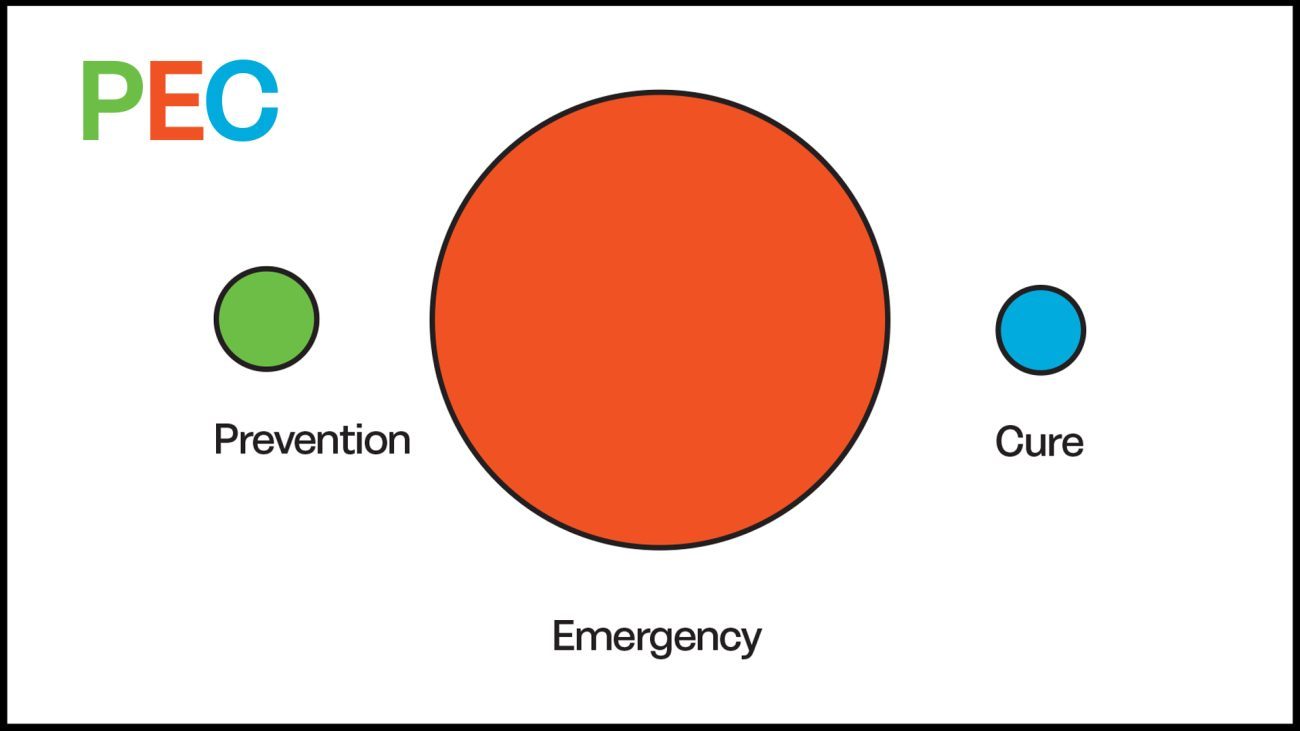
Last week at a talk I gave at Cambridge University I referred to PECC. But I had knocked off ‘Coping’ so PECC became PEC. Prevention, Emergency, Cure. The reason being that Emergency has been extended by the givers to incorporate Coping. Emergency response to a need and crisis in someone’s life meant responding to an emergency, but this blends into coping – because they were never lifted out of the emergency of need. Their hands were held, so to speak, to help them cope, not to cure them of their dire circumstances. In other words, they remained permanently in emergency.
This issue of ‘Permanent Emergency’, keeping you forever in a metaphorical A&E, is finally being discussed with some seriousness. The vast social support and social security bill has finally been realised as a giant sticking plaster for problems, not a cure. Government and opposition are now talking about ‘cutting’, lopping off, even decimating the cost of social security. Because it’s too large and too costly. And also at times because it is too destructive of people’s potential. Not a springboard but a concrete safety net – once you hit it, you’re down for life.
Read more:
Keep reading the journalism that powers our mission
Register free to continue and learn more about the stories, campaigns and the support we provide, helping people facing poverty across the UK.
The recent concern about NEETs – Not in Education, Employment or Training – has emboldened government to look closer at how they allocate resources. How nearly a million young people are stuck, unable to develop their lives and their careers. Up to 15% of those NEETs have been to university and come out with a degree that has not led to a job. And most NEETs have been mopped up by the social security system as their principal provider.
There is concern too about those unavailable to work because for mental or physical reasons. Can some of them be brought into the workforce?
What I discovered all those years ago is that what I now call PEC showed the infinitesimal size of Prevention and Cure versus the enormous size of Emergency. As my diagram shows, governments of differing political persuasions have facilitated the behemothic rise of sticking people into the emergency support category, when there should have been a Cure attached to the emergency help.
Advertising helps fund Big Issue’s mission to end poverty
It is not like they haven’t tried. Universal credit has been developed but was seen as an attack on people trying to get social security. An incredible array of pilots and initiatives, a blizzard of projects have come out of governments over the years. Meanwhile, funding emergency support has become the biggest of all government bills.
Emergency is largely poverty by another name. Ending the inheritance of poverty is the only answer. PEC was my way of uncovering what the government was doing with its money. But also highlighting that most social charities operate in the Emergency zone.
Now, because government has spent its resources on Emergency, putting all of its eggs in one basket, it’s buggered our finances. PEC simply pointed that out. The woman who asked me to help her allocate her generosity chose Emergency – as most people do. It’s the more obvious choice. But it needs Cure attached to its tail. I will return to this subject next week.
John Bird is the founder and editor-in-chief of the Big Issue. Read more of his words from our archive.
Do you have a story to tell or opinions to share about this? Get in touch and tell us more.
Change a vendor’s life.
Advertising helps fund Big Issue’s mission to end poverty
Buy from your local Big Issue vendor every week – and always take the magazine. It’s how vendors earn with dignity and move forward.
You can also support online:
Subscribe to the magazine or support our work with a monthly gift. Your support helps vendors earn, learn and thrive while strengthening our frontline services.
Thank you for standing with Big Issue vendors.