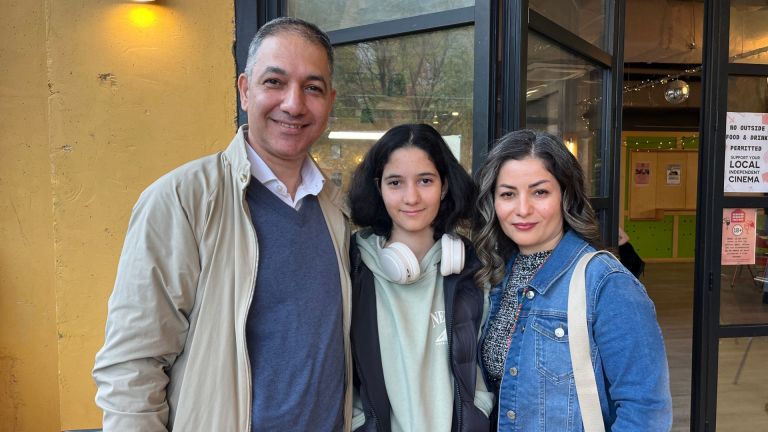
But the hostile narrative trickles down, shaping political discourse and deepening the isolation faced by new arrivals to this country. Our aim with this series is to offer a different picture.
Here is the final instalment in our look at refugees at Christmas.
Grace’s story
For Grace, Christmas means dancing.
“In my country, like, you know, it’s like 85% or 90% are Muslim,” the refugee from Guinea told Big Issue.
“But we would celebrate, it’s a dancing time for people. Back home, it was not like, ‘Oh, you’re Christian or you’re Muslim.’ We just go dancing.”
Big Issue met Grace – not her real name – in November. Advent hadn’t yet begun, but she was already excited.
Advertising helps fund Big Issue’s mission to end poverty
“Everything is shiny and it’s so lovely. You can have your candle at night and a cup of hot chocolate under your blanket with your hot water bottle,” she told me. “So, I like that. I love Christmas.”
This will be her tenth festive season in Britain, after fleeing a traditional family who had subjected her to female genital mutilation.
“I didn’t have any legal representative to help me, even the things I brought, even the proof I brought with me,” she recalled. “When I went to claim asylum, I didn’t bring anything.”
Without English, and without legal support, her asylum claim was refused. She won on appeal, but her newly granted refugee status meant she was required to leave Home Office accommodation. Overnight, she became destitute. To avoid the streets, she moved between unsafe relationships.
Homelessness is all too common for newly-accepted refugees. At the end of 2024, Labour doubled the move-on period to 56 days last year as a six-month pilot, then extended it to the end of this year. But in August, the government reversed course, restoring the four-week limit as part of its drive to close asylum hotels.
Most people cannot understand how that kind of sudden precarity feels, says Grace, and the difficult choices it necessitates.
Advertising helps fund Big Issue’s mission to end poverty
“You have to live this situation to be able to understand,” she said. “Because you have nowhere to go, you have no roof, you have no money, you have no job, nothing. And then someone take you into their home, so you have to have to do whatever they want. You are really, kind of vulnerable.”
A subsequent mental health crisis brought her into contact with Women’s Aid, the Welsh Refugee Council and Asylum Justice: “They saved my life,” Grace says, by helping her find secure housing. Now she is rebuilding: volunteering locally, studying for a master’s in social and public policy.
“I never felt safe… I am safe now,” she said.
But how long will that feeling of safety persist? Increasing anti-immigrant sensationalism has real consequences. A 2022 analysis by the Financial Times’ John Burn-Murdoch showed that public anxiety about immigration has historically risen and fallen in step with the volume of immigration coverage in the Daily Mail.
And in a YouGov poll earlier this year, 52% of respondents said immigration was one of the biggest issues facing Britain – double the proportion (26%) who felt it was a major issue in their own community.
“The data clearly demonstrates that media exposure and political discourse are fanning the flames of anti-immigration sentiment in the UK,” warned Tom Brufatto of Best for Britain, which commissioned the research.
Advertising helps fund Big Issue’s mission to end poverty
Grace feels the impact of that sentiment every day.
“It’s only the bad side of refugee they have seen, not the good side,” she said. “You paint everyone, like, the same. But we are not like this.”
I asked her if she has anything else to add, or anything she would like to tell Big Issue readers.
“Only, Merry Christmas,” she said. “I hope it is nice.”
Do you have a story to tell or opinions to share about this? Get in touch and tell us more.
Change a vendor’s life this Christmas.
Advertising helps fund Big Issue’s mission to end poverty
Buy from your local Big Issue vendor every week – or support online with a vendor support kit or a subscription – and help people work their way out of poverty with dignity.