I'm a single working mum relying on credit to pay bills. Universal credit isn't enough
Thea Jaffe is a full-time working mum who was affected by the two-child limit on benefits. Extra universal credit will help her cover debt – but it's still not enough for her family to afford the essentials
by: Thea Jaffe
24 Apr 2026
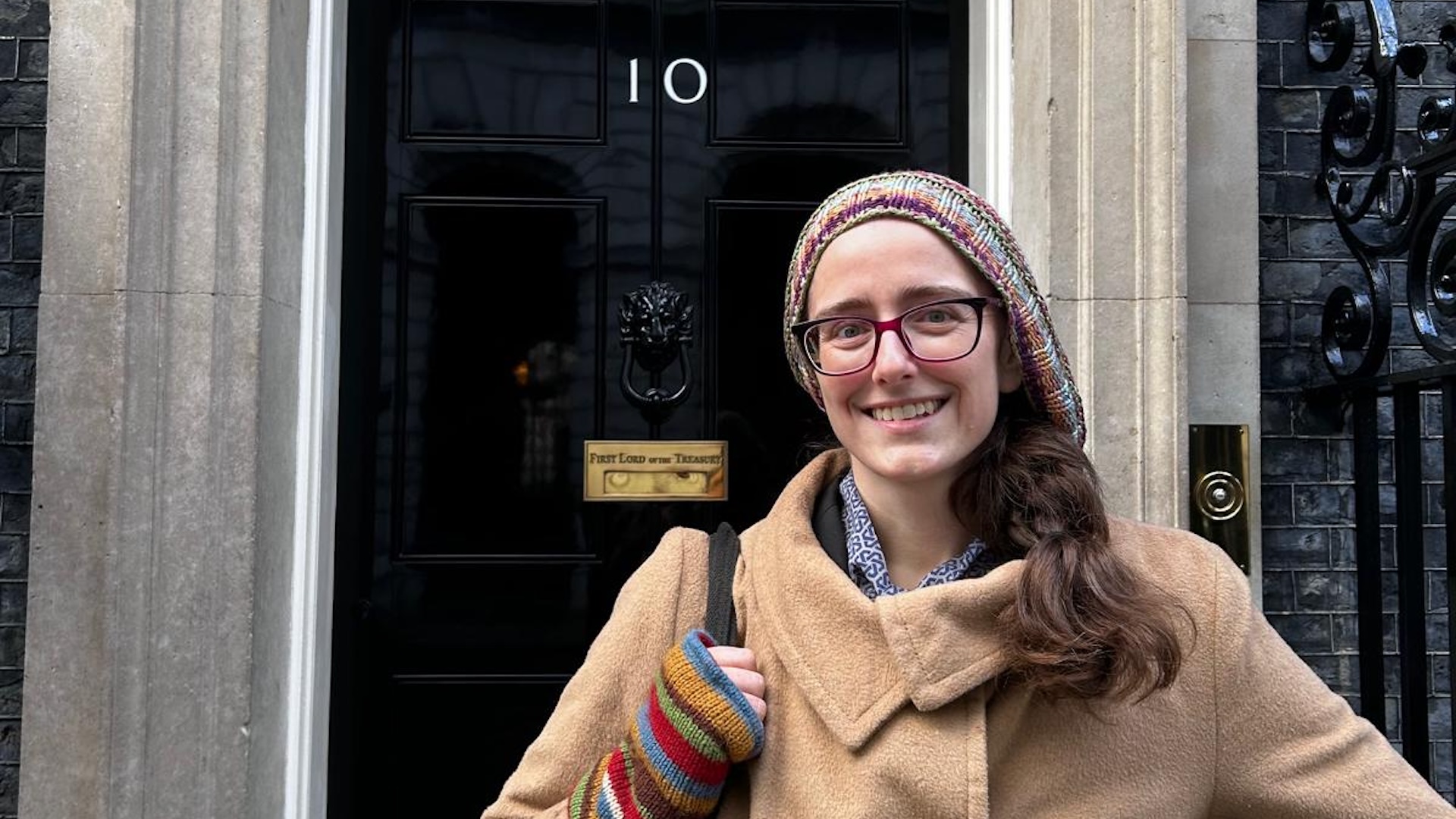
Thea Jaffe outside Number 10 campaigning to end child poverty. Image: Supplied
Share
This month around half a million UK families started receiving letters from Number 10 confirming that all of our children – not just the first two – are now eligible for support through universal credit. As a full-time working single parent of three children, that means a further £303 a month for my family.
During the campaign to abolish the two-child limit on benefits, people often asked what that money meant to us in physical terms. Does it mean extra shoes, raincoats, pints of milk? We do need all of those things. But what will really happen to that extra £303 more complex.
I recently attended the Cost of Living Action campaign launch in Westminster, where the government’s cost of living champion Lord Richard Walker spoke about how expanding access to low-interest (or no-interest) ethical credit could help people weather the current crisis and protect families from worse alternatives like loan sharks. But hearing access to credit framed as a solution to the cost of living broke me in a new way.
Credit is the life raft that keeps me afloat. But it’s also pulling me out to sea.
As skyrocketing childcare costs exceed my salary, my credit card makes work possible. I pay the nursery fees upfront on credit and claim part of that back via universal credit. But when reimbursements are delayed or denied, the resulting shortfall becomes debt that easily snowballs.
Advertising helps fund Big Issue’s mission to end poverty
Advertising helps fund Big Issue’s mission to end poverty
Credit should function as a safety net. But when relied on for basic bills, that net functions more like a trap.
Last year, it trapped my family. A missing universal credit childcare reimbursement of £1,500 sent me from survival into a debt spiral. The next month, I found myself legging it from a corporate conference to a food bank. I cleared my balance, but ran into debt with the nursery. Later I was signed off work due to stress and anxiety, and this year, I reduced my hours. – not to step back from work, but because I literally need more time to manage poverty.
These struggles motivated me to join the Cost of Living Action campaign, while also ironically limiting the time I can realistically give.
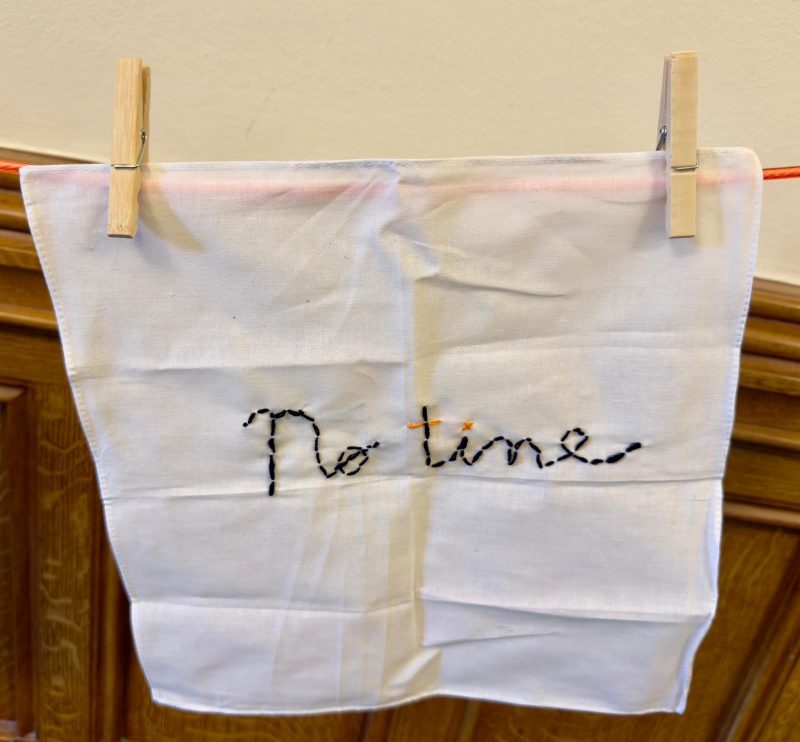
Thea Jaffe stitched ‘No time’ into a piece of linen to sum up her feelings on the cost of living crisis. Image: Supplied
I received a ‘needlework craftivism pack’ ahead of the launch, which gave us a chance to stitch a message onto a piece of linen. I thought I wouldn’t have time. But when I unexpectedly found myself ready for Westminster a whole 20 minutes early, inspiration struck and quickly I stitched “no time” onto my linen square. The front looks neat and efficient – yet turn it over and you will reveal the tangle of threads that reflect what’s really happening for those “surviving” this cost of living crisis. It represents a chaotic web of coping strategies, each with a cost of its own.
As someone with late-diagnosed ADHD, I’ve experienced what happens when “crisis mode” becomes your normal. Life is chaotic, exhausting, and flooded with cortisol. You are so busy reacting that there is no opportunity to plan, prioritise, or act with intention.
Increasingly, this is how the cost of living crisis impacts many families. It’s not just stretching our finances. It’s redefining how we live, contribute, and parent. Life decisions are driven by urgency rather than values. Choices are limited not just by scarcity itself, but by lacking the space and security needed to choose.
Advertising helps fund Big Issue’s mission to end poverty
For working families like mine, the cost of living crisis cannot be measured in single items like shoes, coats or pints of milk, because our finances don’t present in a tidy monthly balance sheet. It looks more like a never ending game of Tetris where the problems keep falling faster and harder.
At the Cost of Living Action launch, one MP pointed out how poverty data misses families like mine – those who are “just about managing,” whose wages are decent yet eclipsed by costs like rent and childcare. In-work poverty often remains invisible because poverty studies measure income against a theoretical line rather than each family’s real essential costs.
If we are serious about “getting Britain working again” we need to confront the fact that work no longer guarantees stability. The fragile appearance of “just about managing” is held together with debt. This debt is not only financial but emotional, psychological, and physiological – and it’s carried by our children too.
How long does this crisis have to continue before we admit that crisis is so ingrained in the system itself, that true solutions need to be structural, not reactive?
By ending the two-child limit the government has shown that structural solutions are possible. But as global instability pushes fuel, energy and food prices even higher, the pressure on our safety nets intensifies. In a system where wages aligned with rent and childcare, wealth was taxed fairly, and welfare aligned with the cost of living, families would be better able to absorb shocks like the wars in Ukraine and Iran.
This is what the Cost of Living campaign is calling for: to move from reactive crisis management to preventative action. It cannot just be about emergency support – it must also reduce the need for it in the first place by bringing wages and welfare in line with living costs, tackling profiteering in housing, food and energy, and taxing wealth effectively.
Advertising helps fund Big Issue’s mission to end poverty
The real question is not what a family can do with an extra £303. It’s whether we are willing to address the structural inequalities that drive a working parent to claim universal credit in the first place.