Read more:
What’s the reality?
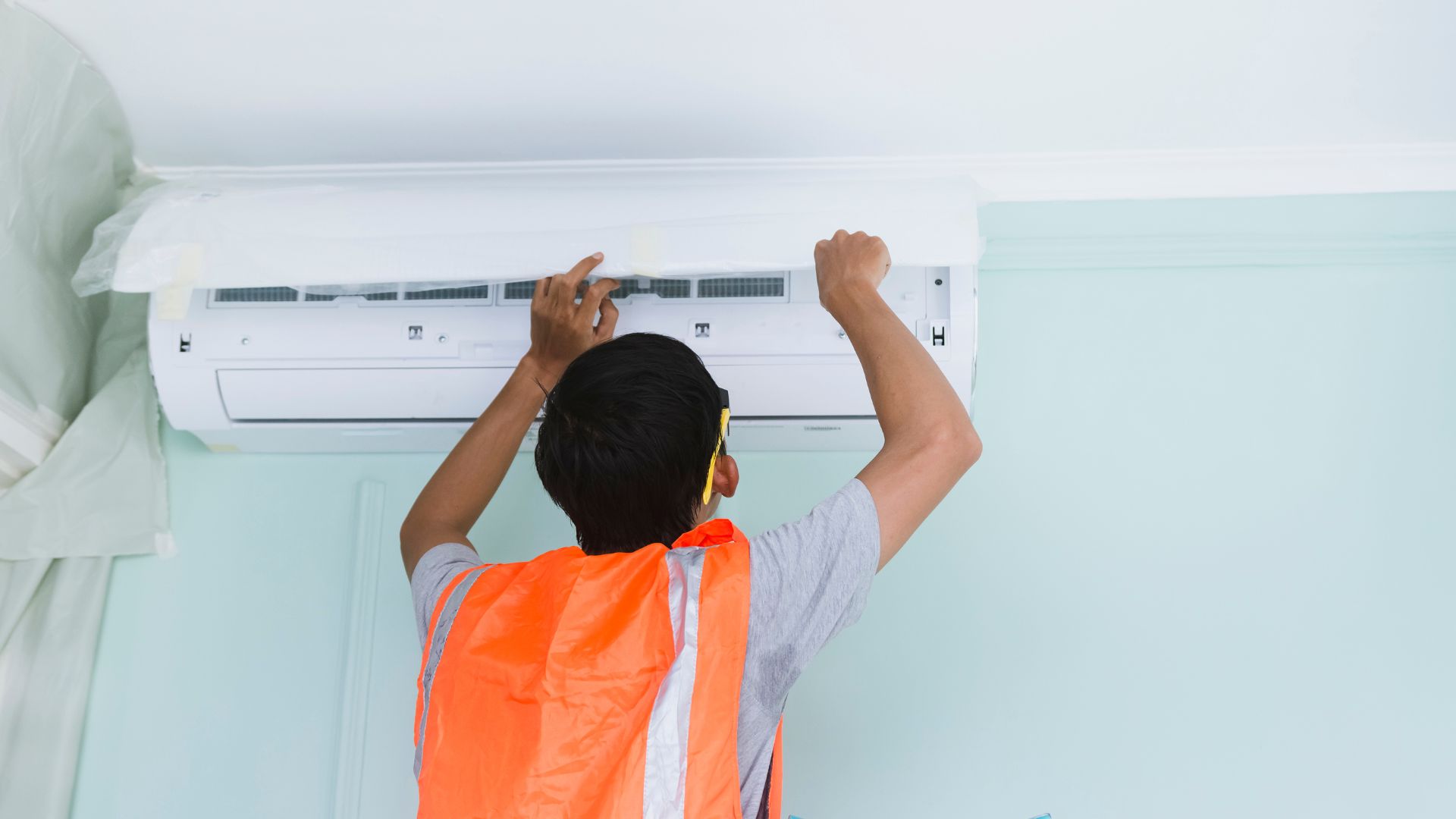
“There definitely isn’t an official ban,” says Rosalie Callway, policy manager at Town and Country Planning Association. “What they are talking about is a mixture of building regulations, but there’s nothing that explicitly preventing air conditioning.”
Under current regulations, builders must prioritise “passive” ways of keeping new homes cool – like window coverings and cross-ventilation – before installing active systems. These limiting rules were drawn up under Conservative housing secretary Robert Jenrick, who has since defected to Reform UK.
Keep reading the journalism that powers our mission
Register free to continue and learn more about the stories, campaigns and the support we provide, helping people facing poverty across the UK.
Where passive measures won’t work, air conditioning can still be installed – and existing homes face no restrictions at all. An estimated four million UK homes now have air conditioning, double the figure from three years ago, The Guardian recently reported.
Passive cooling is also more effective than it sounds. “The Passivhaus standard… it’s like an insulating system,” says Callway. “It keeps a building internally the same sort of temperature all year round. It doesn’t get excessively cold in the winter, but it doesn’t get excessively hot in the summer. That means you just don’t need as much energy either to heat the building or to cool it. People living in those sorts of flats will save money because they’re built more efficiently from the outset.”
External shading alone can reduce heat gain from the sun by up to 92%, according to the University of East London.
Advertising helps fund Big Issue’s mission to end poverty
The 3% statistic on how many British homes have air conditioning is accurate, but Coutinho has mischaracterised why it is so low. The reason Britain has historically had so little air conditioning isn’t regulatory, it’s down to a cooler climate. The UK has historically been much cooler than Japan, Korea, or the American south.
That is changing: a total of 92% of existing UK homes are at risk of overheating in 2050, a recent Climate Change Committee report said. Most of the risk of heat-related deaths can be avoided in the 2050s by adapting 30% of the most vulnerable urban households in the next few years.
“There’s a threshold where [passive methods] only do so much,” says Callway. “But the point is to start with… reducing emissions, because that’s what is causing the global heating in the first place.
“If the building isn’t designed in the right way from the outset, it just becomes so much harder to then deal with the consequences of overheating. We need to try and avoid [that] first before we think about then mitigating the overheating that’s happened because we haven’t designed our houses well.”
Air conditioning accounts for around 4% of global emissions. Bob Ward, head of the Grantham Institute for Climate, took to X to criticise Coutinho’s policy on these grounds.
“The Conservatives will not try to stop heatwaves from becoming ever more intense and frequent, but will just encourage everybody to get air conditioning to deal with temperatures as they exceed 40C, 45C, 50C etc,” he said.
Advertising helps fund Big Issue’s mission to end poverty
Do you have a story to tell or opinions to share about this? Get in touch and tell us more.
Change a vendor’s life.
Buy from your local Big Issue vendor every week – and always take the magazine. It’s how vendors earn with dignity and move forward.
You can also support online: Subscribe to the magazine or support our work with a monthly gift. Your support helps vendors earn, learn and thrive while strengthening our frontline services.
Thank you for standing with Big Issue vendors.
Advertising helps fund Big Issue’s mission to end poverty